
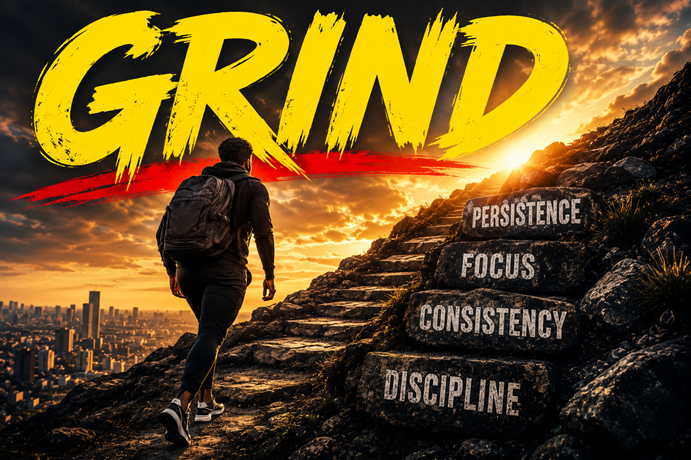
Somewhere right now, someone is setting an alarm for 5 a.m. while their friends are still asleep. Somewhere else, someone is closing their laptop at midnight after a full day of classes, still chasing a side project nobody else believes in yet. Nobody is clapping for them. No one is watching. There’s no trophy waiting at the end of the week.
That’s the grind.
It’s not glamorous. And it’s not what gets posted on Instagram. It’s the unseen, unsexy, repetitive work that happens long before anyone calls you “successful.” And here’s the truth most people don’t want to hear: talent doesn’t separate dreamers from achievers. Grind does.
Everyone has dreams. Fewer people have the discipline to show up for those dreams every single day, especially when motivation disappears and results are nowhere in sight. This article isn’t about hustle-culture burnout or glorifying exhaustion. It’s about understanding what real, sustainable grind looks like-and how you can build it into your daily life starting today.
What Does “The Grind” Really Mean?
The grind isn’t a single heroic effort. It’s not the all-nighter before a deadline or the one intense workout after months off. The grind is the boring middle-the daily, consistent action you take toward a goal even when you don’t feel inspired, even when no one is watching, even when progress feels invisible.
Think of it like a river carving through solid rock. No single drop of water does the carving. It’s the relentless repetition, day after day, year after year, that eventually reshapes the landscape. That’s the grind: small, consistent efforts compounding into something massive over time.
The grind means:
- Showing up when you don’t feel like it
- Doing the unglamorous tasks nobody sees
- Choosing discipline over mood
- Trusting the process even when results are slow
It’s not about working yourself into the ground. It’s about consistency with purpose.
Why Most People Quit Before Success
Here’s an uncomfortable statistic: most people who start a new habit, business, or goal quit within the first few weeks. Not because they lack talent. Not because the goal was impossible. They quit because they hit the “invisible middle”-the stretch where the excitement of starting has worn off, but the rewards of finishing haven’t arrived yet.
This is where dreams die.
People quit because:
1. They expect linear results
They think effort should immediately translate to visible progress. When it doesn’t, they assume they’re failing.
2. They rely on motivation instead of systems
Motivation is a spark, not fuel. It gets you started but rarely gets you to the finish line.
3. They compare their Chapter 1 to someone else’s Chapter 20
Social media shows the highlight reel, not the years of grinding behind it.
4. They underestimate how long real change takes
Most meaningful goals take months or years, not days or weeks.
The people who succeed aren’t the ones who never feel like quitting. They’re the ones who keep going anyway.
Grind vs Burnout: Understanding the Difference
This is where so many well-meaning ambitious people get it wrong. They confuse grinding with grinding themselves into the ground. These are not the same thing, and mixing them up can cost you your health, relationships, and motivation.
| Grind | Burnout |
|---|---|
| Purposeful, consistent effort | Constant, unsustainable overexertion |
| Includes rest as part of the plan | Ignores rest entirely |
| Driven by long-term vision | Driven by fear or guilt |
| Adaptable and sustainable | Rigid until it breaks you |
| Builds momentum over time | Leads to exhaustion and quitting |
Real grind has rhythm. It has seasons of intense focus and seasons of recovery. It respects sleep, boundaries, and mental health because it understands that a person who burns out at month three will never make it to year three.
The goal isn’t to sacrifice your wellbeing for success. The goal is to build discipline that you can sustain for the long haul; because success isn’t a sprint. It’s closer to training for a marathon you don’t know the finish line of yet.
The Hidden Benefits of Grinding
Beyond the obvious (achieving your goals), the grind quietly builds things that matter far beyond any single outcome.
- Self-trust. Every time you show up when you didn’t want to, you prove to yourself that your word means something.
- Resilience. Grinding through difficulty teaches you that discomfort is survivable, which makes future obstacles less scary.
- Identity transformation. You stop being someone who wants to be a writer, entrepreneur, or athlete, and start becoming one-one repetition at a time.
- Clarity. Consistent action reveals what you actually enjoy, what you’re good at, and what isn’t working, far faster than thinking ever could.
- Compounding skill. Like interest in a bank account, small daily improvements stack until they create outsized results.
The grind isn’t just a means to an end. It’s the process that quietly builds the person capable of handling the success they’re chasing.
Daily Habits That Build a Strong Grind Mentality
You don’t need a radical life overhaul to build grind discipline. You need small, repeatable habits that compound.
1. Start with a non-negotiable morning anchor
One small action-journaling, a workout, reading 10 pages; done every morning regardless of mood. This sets the tone: today, discipline leads, not feelings.
2. Use the “2-Minute Rule” to beat resistance
Whenever motivation is low, commit to just two minutes of the task. Often, starting is the hardest part-momentum takes care of the rest.
3. Track your effort, not just your outcomes
Keep a simple habit tracker or journal. Celebrate showing up, not just winning.
4. Protect a distraction-free deep work block
Even 60–90 minutes of focused, phone-free work daily can outproduce entire distracted days.
5. Review weekly, adjust monthly
Grind isn’t blind repetition. Check in with yourself regularly to refine your approach.
6. Sleep like it’s part of the job
Treat recovery as seriously as you treat effort. Under-slept grind is short-lived grind.
Common Mistakes People Make While Grinding
Even well-intentioned grinders sabotage their own progress. Watch for these traps:
- Confusing busyness with productivity. Being tired doesn’t mean you’re making progress. Working smart matters as much as working hard.
- Ignoring recovery. Skipping sleep, meals, and relationships to “grind harder” backfires and shortens your runway.
- Chasing motivation instead of building systems. Waiting to “feel ready” keeps you stuck. Systems don’t need motivation; they run on autopilot.
- Grinding without a clear direction. Effort without a target is just exhaustion. Know why you’re grinding, not just that you are.
- Comparing your grind to someone else’s highlight reel. Your timeline is yours. Comparison kills consistency.
Avoiding these mistakes is often what separates people who grind sustainably for years from those who flame out in months.
How to Stay Motivated When Results Are Invisible
This is the true test of the grind: continuing to show up when nothing seems to be happening.
Reframe “no results” as “invisible progress.” Think of a bamboo tree; it spends its first five years growing roots underground before shooting up 90 feet in six weeks. From the outside, it looked like nothing was happening. Underneath, everything was.
Focus on process goals, not outcome goals. Instead of “I want 10,000 followers,” aim for “I will post consistently three times a week.” You control the process; the outcome follows.
Find a “why” bigger than your mood. Motivation fluctuates daily. Purpose doesn’t. Anchor your grind to something meaningful; your family, your future, your integrity-not just how you feel today.
Surround yourself with proof that grinding works. Read biographies, follow people further along the path, and remind yourself regularly that consistency compounds even when it’s silent.
Give yourself permission to grind imperfectly. Missing a day doesn’t erase progress. Quitting does. Progress isn’t a straight line, and that’s normal, not a failure.
Real-Life Examples of Successful People Whose Success Came Through Consistent Grinding
- Thomas Edison tested thousands of materials before finding one that worked for the light bulb filament. His grind wasn’t glamorous-it was thousands of quiet, unremarkable attempts.
- J.K. Rowling was rejected by multiple publishers before Harry Potter was accepted, all while raising a child as a single parent and facing financial hardship. Her grind happened in obscurity, long before any bestseller lists.
- Michael Jordan was famously cut from his high school varsity basketball team. Instead of quitting, he used it as fuel, showing up to practice earlier and staying later than his teammates for years afterward.
- Sara Blakely, founder of Spanx, sold fax machines door-to-door for years while developing her product idea on the side, facing rejection from manufacturers repeatedly before finding success.
- Stephen King reportedly papered his wall with rejection letters early in his career, continuing to write consistently despite dozens of “no’s” before his breakthrough.
None of these stories are about overnight success. They’re about people who kept grinding through invisible, unglamorous years before the world ever noticed.
Actionable Steps You Can Implement Immediately
- Choose one goal you’ve been putting off and identify the smallest possible daily action tied to it.
- Set a fixed time each day to do that action; same time, same place, non-negotiable.
- Track it visually (a calendar, app, or journal) so you can see your streak build.
- Define your process goals for the next 30 days instead of fixating on outcomes.
- Schedule recovery into your week just like you schedule work-rest is part of the grind, not the opposite of it.
- Find one accountability partner or community to check in with weekly.
- Review every Sunday: What worked? What didn’t? What’s one adjustment for next week?
Small, repeated actions like these are how dreamers quietly become achievers.
Conclusion: The Grind Is the Bridge Between Who You Are and Who You’re Becoming
There is no shortcut around the grind. No app, no life hack, no motivational video can replace the discipline of showing up, day after day, for a goal that hasn’t paid off yet. But that’s exactly why it works-because most people won’t do it.
The distance between dreaming and achieving isn’t talent, luck, or timing. It’s the willingness to keep grinding through the invisible middle, long after motivation fades and long before recognition arrives.
You don’t need to be perfect. And you don’t need to grind yourself into exhaustion. You just need to keep showing up, one honest day at a time.
Your future self is being built right now, in the small, unglamorous choices you make today.
“Success isn’t created in the moment you’re celebrated. It’s built in all the quiet moments before anyone was watching.“
Frequently Asked Questions
1. What does “the grind” mean in personal development? The grind refers to the consistent, often unglamorous daily effort required to achieve long-term goals, even when motivation is low or results aren’t yet visible.
2. Is grinding the same as burnout? No. Grinding is sustainable, purposeful effort that includes rest and recovery. Burnout is unsustainable overexertion that ignores rest and eventually leads to exhaustion or quitting.
3. How do I stay motivated when I don’t see results? Focus on process goals rather than outcomes, track your consistent effort, and remind yourself that meaningful progress is often invisible before it becomes visible.
4. Can grinding too hard be harmful? Yes. Without proper rest, boundaries, and balance, grinding can lead to burnout, health issues, and ultimately abandoning your goals altogether.
5. How long does it take to build a strong grind mentality? Most people begin noticing real momentum after 60–90 days of consistent daily habits, though meaningful mastery often takes months or years of sustained effort.
You may also like this:
 Men Who Continually Succeed In Life Often Follow These 10 Daily Habits
 Top 10 Sources of Inspiration to Motivate You Daily
 Boost Your Motivation: Top 5 Proven Techniques
 5 Books That Will Help You Master Self-Discipline
 5 Books That Will Give You the Life-Changing Inspiration for Success
 How to Develop Winning Mental Strength in 2025
 4 Powerfull Ways of Using Affirmations to Shape Your Reality
 The 10 Golden Rules of Life You Learn with Age That Lead you to Success