
Artificial intelligence is transforming the tech industry and raising many questions. As AI gets better at coding, designing, analyzing data, and even fixing software, many people are asking if their tech skills will soon be outdated.
The good news is that your skills are still needed, but there’s a catch. AI is changing our work, but it can’t replace the human qualities that make technology valuable. It can automate tasks and spot patterns, but it can’t match our judgment, ethics, empathy, or big-picture thinking.
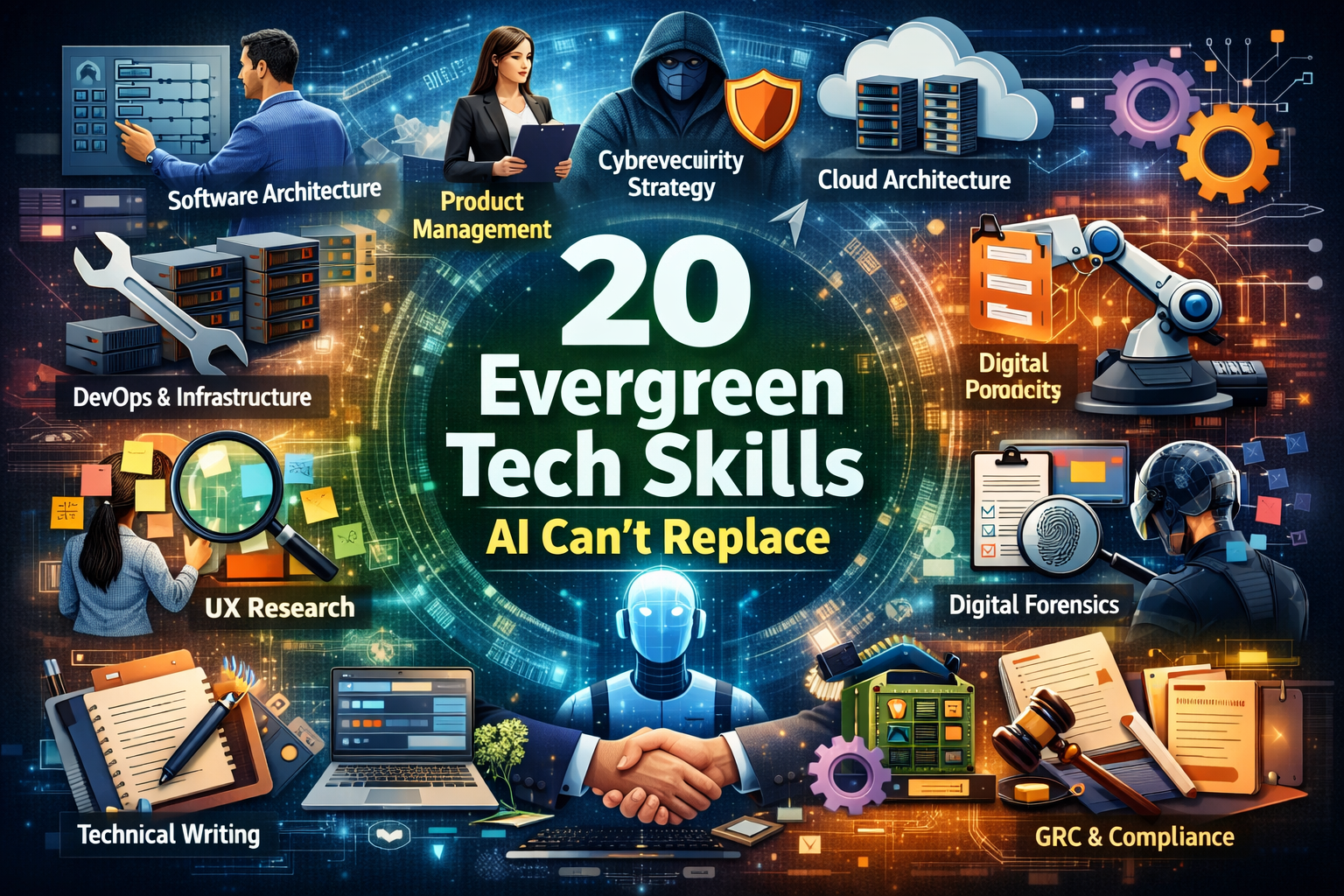
This guide covers 20 tech skills that AI is unlikely to replace. These skills can help you build a strong tech career for years to come. For each one, you’ll see what it is, why AI can’t do it, how to learn it, and how to keep it up to date.
Whether you’re an entrepreneur, developer, student, or experienced professional, this guide will help you feel confident as AI changes the tech world.
1. Software Architecture & System Design
Software architecture is the foundation of today’s technology systems. ([2025 Architecture in Software Development Report: Rethinking the Role of Architecture in the Age of AI, Architects plan how software parts work together, scale, and stay secure in real situations. This skill is needed in almost every tech field, from fintech and healthtech to SaaS and e-commerce platforms.
Why AI Cannot Replace It
AI can recommend architecture patterns and spot possible issues, but it cannot handle the tough choices that come with real-world decisions. Questions like whether to focus on cost or performance, how to balance security and user experience, or how much technical debt is acceptable all need a deep understanding of business, company politics, rules, and long-term goals. These are areas where only human judgment works.
How to Acquire This Skill
Start by learning programming basics in several languages to see different approaches. Study well-known design patterns, then move on to patterns for distributed systems. Build real projects, starting simple and making them more complex over time. Look at case studies, such as how Netflix keeps streaming reliable or how Uber manages real-time location data. Read technical blogs from top engineering teams.
Staying Relevant
The world of software architecture is always changing. Stay up to date with cloud-native designs, microservices, serverless, and edge computing. Take part in architecture reviews to sharpen your decision-making. Learn about new technologies like WebAssembly and how they affect design. Most importantly, practice balancing different needs. Your decision-making skills will grow with each project.
2. Product Management
This product management connects business strategy, user needs, and what is technically possible. Product Management 101 Coaching and Learning, 2024. Product managers turn ideas into products people want. They are key in startups building their first product, SaaS companies adding features, mobile app teams improving user experience, and large companies meeting complex needs.
Why AI Cannot Replace It
At its heart, product management requires empathy-the ability to understand what users really need, not just what they say. It also means making tough choices when things are uncertain, working with people who have different goals, and planning for future market changes. AI can look at user data and suggest features, but it cannot take responsibility for a product’s success or handle the human side of decisions.
How to Acquire This Skill
Begin by learning product frameworks like Agile for development, Scrum for teamwork, and OKRs for setting goals. Get good at user research methods such as interviews, surveys, usability tests, and data analysis. Practice communicating with stakeholders by leading projects, even small ones, where you need to bring people together. Study successful products to see what made them work, and look at failures too-they often teach more.
Staying Relevant
Stay in touch with users by holding regular interviews and feedback sessions. Keep up with market trends by following analysts, going to conferences, and watching competitors. Build your leadership and storytelling skills, since great product managers inspire their teams. Use AI tools to help, but remember that the big decisions are still yours.
3. Cybersecurity Strategy & Risk Management
Cybersecurity professionals protect our digital world by keeping systems, data, and networks safe from new threats. This skill is essential in banking, government, healthcare, telecom, and cloud platforms that handle sensitive information and millions of users.
Why AI Cannot Replace It
AI excels at detecting anomalies and identifying potential threats based on patterns, but cybersecurity demands more. Humans must define what level of risk is acceptable for their organization, make split-second decisions during active attacks, communicate with stakeholders during crises, and navigate the ethical dimensions of security work. When a breach occurs, it’s humans who face legal consequences and must explain decisions to boards and customers.
How to Acquire This Skill
Build a foundation in networking fundamentals and system security principles. Get hands-on experience with security tools-firewalls, intrusion detection systems, security information and event management (SIEM) platforms. Study threat modStart by learning the basics of networking and system security. Get practical experience with tools like firewalls, intrusion detection systems, and SIEM platforms. Study how attackers think by learning threat modeling. Practice on sites like HackTheBox or TryHackMe. Consider certifications such as CISSP, CEH, or Security+ to show your skills.practice incident response through tabletop exercises and red team/blue team drills. Develop expertise in emerging areas like cloud security, IoT security, and AI security.
4. DevOps & Infrastructure Engineering
DevOps engineers connect development and operations, making sure applications are reliable, can scale, and stay available. This role is vital for SaaS companies, cloud platforms with many users, and any large system where downtime is costly.
Why AI Cannot Replace It
While AI can automate repetitive deployment tasks and predict resource needs, DevOps requires human judgment during critical moments. When systems fail at 3 AM, engineers must diagnose unfamiliar issues, make trade-off decisions under pressure, and communicate with stakeholders. Designing resilient workflows requires understanding organizational culture, team capabilities, and business priorities—context AI cannot fully grasp.
How to Acquire This Skill
Master Linux system administration, the foundation of most server infrastructure. Learn CI/CD tools like Jenkins, GitLab CI, or GitHub Actions. Understand containerization with Docker and orchestration with Kubernetes. Gain proficiency with cloud platforms—AWS, Azure, or Google Cloud. Build actual deployment pipelines for projects, even personal ones, to understand the full lifecycle.
Staying Relevant
DevOps tools change quickly. Try new tools and platforms, but focus on core principles instead of just technology. Learn site reliability engineering (SRE) for better reliability. Practice infrastructure as code with tools like Terraform or Pulumi. Build skills in observability, such as metrics, logging, and tracing, to understand your systems.
5. Cloud Architecture
Cloud architects design scalable, secure, and cost-effective solutions leveraging cloud platforms like AWS, Azure, or Google Cloud. They serve businesses migrating from on-premises infrastructure, startups building cloud-native applications, and enterprises optimizing their cloud spend while maintaining compliance.
Why AI Cannot Replace It
Choosing a cloud architecture means balancing many factors, like industry rules, costs, business continuity, and performance needs. These choices need a deep understanding of business, regulations, and risk tolerance. AI can suggest options, but it cannot take responsibility for the results.
How to Acquire This Skill
Begin by learning the basics of cloud computing, storage, networking, and security on major platforms. Design cloud solutions for things like web apps, data pipelines, and machine learning. Practice saving costs by reviewing spending and adjusting resources. Get certified as an AWS, Azure, or Google Cloud architect.
Staying Relevant
Cloud platforms add new services all the time. Keep up with provider updates and try out new features. Work on making your architectures both cost-effective and high-performing, even when these goals conflict. Learn about using multiple clouds and hybrid strategies, and explore green computing practices.
6. Data Engineering
Data engineers create the systems that collect, clean, and organize data so it can be used for analytics and AI. They are needed in any field where data is important, such as e-commerce, healthcare, finance, and tech companies training AI models.
Why AI Cannot Replace It
AI systems rely on data engineers to work properly. People must decide what good data looks like, set rules for data use, judge what matters for the business, and design systems that balance speed and cost. These choices need business knowledge and context that AI does not have.
How to Acquire This Skill
Learn SQL for working with data and Python for scripting. Get to know ETL tools like Apache Airflow, dbt, or Talend. Understand data modeling for analytics and transactions. Practice with big data tools like Apache Spark and cloud data warehouses such as Snowflake or BigQuery. Work with both batch and streaming data pipelines.
Staying Relevant
The data engineering landscape is rapidly modernizing. Master the modern data stack—cloud data warehouses, reverse ETL, data orchestration, and data observability tools. Focus on data governance and privacy compliance as regulations tighten globally. Develop expertise in real-time data processing as organizations demand faster insights. Learn about data mesh and other emerging architectural patterns.
We’ve only scratched the surface. In the next part, we explore deeper, high-level skills like strategy, innovation, and leadership that AI cannot replace. Advanced AI-resistant tech skills
This emerging field ensures AI systems operate fairly, transparently, and in compliance with laws and ethical standards. It’s critical in finance where AI makes lending decisions, healthcare where AI assists in diagnosis, government agencies deploying AI for public services, and any organization where AI impacts human lives.
Why AI Cannot Replace It
AI cannot set its own ethical rules, which is a clear problem. People must set ethical limits, create accountability, check AI for bias, and decide what to do when AI’s advice goes against human values. This takes moral reasoning, understanding of society, and a willingness to take responsibility.
How to Acquire This Skill
Study ethics, philosophy, and how to reason about morals. Learn the basics of AI and machine learning to know what you are overseeing. Get familiar with privacy laws like GDPR, new AI rules, and industry standards. Learn how to spot and reduce bias. Review case studies of AI failures and their effects on society.
Staying Relevant
AI rules are changing quickly in different places. Keep up with new laws like the EU AI Act, US state laws, and global standards. Join policy talks at conferences and in working groups. Learn about explainable AI and how to make AI decisions clear. Help connect technical teams with legal and compliance groups.
8. UX Research & Human-Centered Design
UX researchers design products and services based on deep understanding of how people think, what they need, and what they like. They are key in mobile apps, websites, enterprise software, and any technology people use directly. Empathy – the ability to feel and understand the feelings of another—cannot be automated. AI can analyze user behavior data, but it cannot feel the frustration of a confusing interface, understand the anxiety of a first-time user, or recognize unspoken needs revealed through observation. Human-centered design requires the human element.
How to Acquire This Skill
Learn design thinking and how to see problems from the user’s point of view. Get good at research methods like interviews, usability tests, surveys, and observing users. Practice turning research into useful insights. Try wireframing and prototyping to share your ideas. Study psychology and behavior to understand how people make decisions.
Staying Relevant
Keep doing user research, since assumptions can become outdated fast. Test your ideas often with validation studies. Stay connected to users, not just during research sessions. Learn new research methods and adapt to new ways people interact, like voice, AR/VR, and AI-powered interfaces.
9. Technical Leadership & Engineering Management
Engineering managers lead technical teams, mentor engineers, align technical execution with business objectives, and create environments where engineers thrive. They are important in growing tech companies, startups moving to structured teams, large organizations, and anywhere technical work needs coordination. They must accept accountability for team outcomes, make difficult people decisions, navigate organizational politics, and inspire teams during challenging times. These deeply human capabilities cannot be automated.
How to Acquire This Skill
First, get senior engineering experience to build credibility. Learn management through books, courses, and mentors. Start by leading small projects before managing people. Build communication skills, like giving feedback and resolving conflicts. Study how organizations and teams work. Practice being open and genuine as a leader.
Staying Relevant
Keep improving your people skills with feedback and coaching. Adjust your leadership style for different team members and situations, since what works for one person may not work for another. Stay up to date technically so you can understand your team’s work. Connect with other engineering leaders to share experiences and learn best practices.
10. Systems Integration & Legacy Modernization
This skill involves connecting legacy systems built decades ago with modern technologies. It’s a common challenge in banks with mainframes, government agencies with old infrastructure, insurance companies with old policy systems, and any business where replacing everything isn’t possible. Documentation is often incomplete, original developers long gone, business logic embedded in undocumented ways. Understanding these systems requires detective work, institutional knowledge, and tolerance for ambiguity. Making integration decisions requires balancing risk, cost, and business continuity – judgment AI cannot provide.
How to Acquire This Skill
Learn how to design APIs and use integration patterns like REST, GraphQL, SOAP, and message queues. Understand middleware that connects different systems. Get experience with legacy platforms such as mainframes, COBOL, and older software. Build patience and troubleshooting skills. Learn about change management, since updating systems affects both people and processes.
Staying Relevant
Learn strategies for modernizing systems, like the strangler fig pattern, anti-corruption layers, and event-driven architectures. Stay flexible as integration technologies change. Get good at planning migrations and managing risks. Improve your communication skills to set expectations with stakeholders during long modernization projects.
Why These Skills Endure
The skills listed here have qualities that make them hard for AI to replace:
Human Judgment: They require making decisions under uncertainty with incomplete information, weighing competing priorities, and accepting accountability for outcomes.
Contextual Understanding: They demand deep understanding of organizational culture, business objectives, regulatory environments, and human needs that extend beyond what can be captured in training data.
Ethical Reasoning: They involve moral dimensions where right and wrong aren’t algorithmically determinable, requiring human values and philosophical frameworks.
Emotional Intelligence: They require empathy, relationship-building, conflict resolution, and other capabilities rooted in human emotional experience.
Strategic Vision: They demand thinking beyond immediate optimization to anticipate future states, imagine possibilities, and align actions with long-term goals.
Accountability: They require someone who can be held responsible for decisions, face consequences, and explain reasoning to stakeholders.
Building Your Future-Proof Career
The key to thriving in an AI-augmented future isn’t competing with AI – it’s complementing it. Use AI as a powerfuTo succeed in a future with AI, don’t try to compete with it – work alongside it. Let AI handle routine tasks so you can focus on the human parts of your job. Build skills in judgment, creativity, empathy, and strategic thinking.pth with soft skills-a DevOps engineer who communicates effectively with business stakeholders, a data engineer who understands ethics, a product manager with technical credibility.
Stay curious and keep learning. Technology changes all the time, but core human skills stay important. Read widely, not just in your field. Look for different experiences to build your understanding of context. Build relationships with people in other areas and industries.
Most importantly, see AI as your partner, not your replacement. Learn to use AI tools well, but remember that big decisions, ethics, and human relationships are still your responsibility.
If you’re serious about building a truly future-proof career, don’t stop here. The next set of skills dives into leadership, entrepreneurship, and AI collaboration. Future-proof tech skills (Part 2)
Conclusion
The rise of AI isn’t removing the need for human expertise – it’s making it even more important. As AI takes over routine tasks, human skills like judgment, ethics, empathy, leadership, and vision become even more valuable for tech careers.
By building these lasting skills, you’re not just avoiding automation – you’re setting yourself up for more impact and influence. The future is for people who mix technical skills with human wisdom, using AI as a tool while bringing judgment, accountability, and ethics that only humans have.
The technology industry will continue toThe tech industry will keep changing, but one thing stays the same: technology is here to serve people, and people must guide how it’s made and used. Your future in tech is safe when you focus on what makes you uniquely human.reen tech skills that AI cannot replace. Learn why human judgment, empathy, and strategic thinking remain essential in software architecture, cybersecurity, product management, and more. Future-proof your tech career today.